
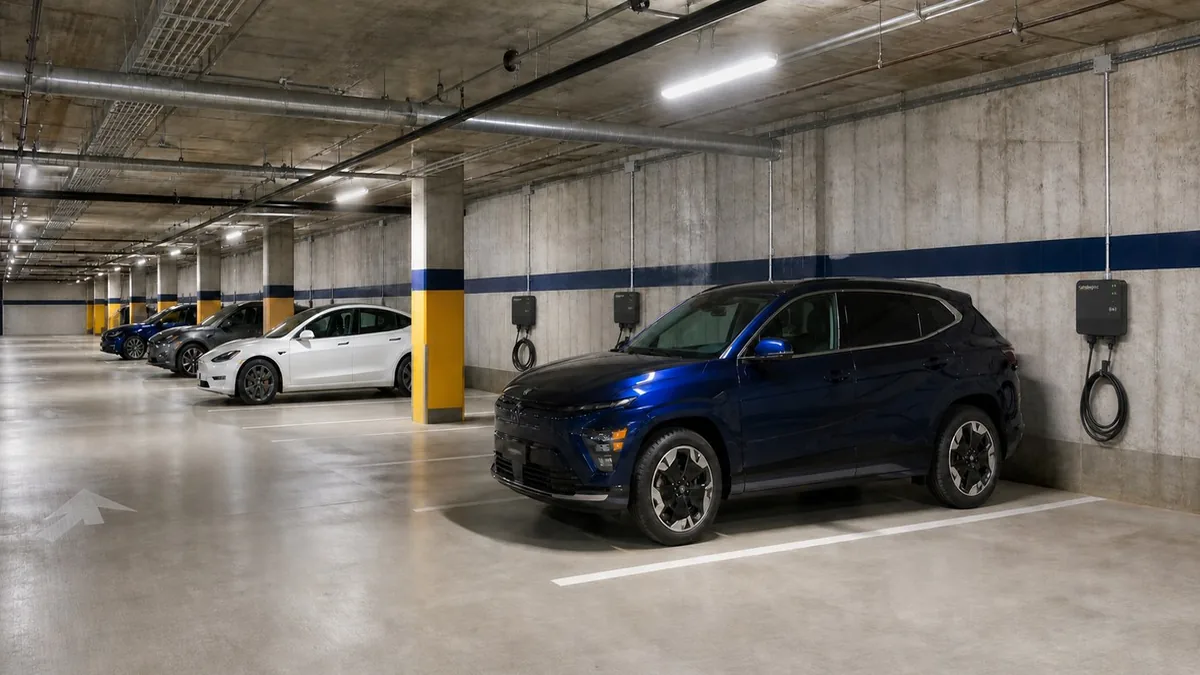
How Variablegrid worked with BC Hydro to prove that multi-unit residential buildings (MURBs) and EV charging can deliver meaningful peak demand reduction.
“Variablegrid helped us achieve meaningful power reductions during demand response events.”Alec Zaine, Program Manager, Demand Response (Commercial & Industrial), BC Hydro
The Client
BC Hydro is British Columbia’s primary electric utility, serving more than 5 million people across the province. As EV adoption accelerated across the Lower Mainland, BC Hydro needed to prove a thesis: that managed residential charging could become a dispatchable grid resource, not just a growing load.
They partnered with Variablegrid on a pilot project.
The Challenge
EV charging in multi-unit residential buildings (MURBs) stacks onto the grid at exactly the wrong time: weekday evenings between 5 p.m. and 9 p.m., when residential demand already peaks.
Before BC Hydro could scale a commercial demand response program for this segment, three questions had to be answered with real data.
Can MURB charging be curtailed reliably during peak windows?
Will strata residents actually participate when asked to shift a charging session?
What does the per-driver kW reduction look like in practice, not in a model?
The Solution
Variablegrid has two capabilities no other partner can provide: controlling EV chargers at scale inside strata buildings, and delivering utility-grade, granular data on every event, every charger, every driver.
The result was a 200-site pilot that behaved like a single grid asset. BC Hydro scheduled events, Variablegrid dispatched them, and every charger reported back in 15-minute intervals, across two full peak seasons.
Program at a glance
Execution That Delivered
Variablegrid ran the pilot end to end: driver onboarding, event dispatch, opt-out handling, curtailment, and utility reporting, across a mixed hardware fleet spanning VarianRS40, Grizzl-E Smart, EVoCharge, and more. That heterogeneity is the real world of strata charging, and Variablegrid’s platform presented it to BC Hydro as a single, dispatchable resource.
- 100% event delivery. All 23 events delivered on the BC Hydro schedule, from Friday June 13, 2025 through Friday February 20, 2026.
- On-contract reporting. 15-minute interval data, per charger, per event.
- Seasonal performance reports delivered to BC Hydro on October 2, 2025 and March 3, 2026, providing a clean, auditable data set for each peak season.
- Hundreds of strata residents onboarded with individual opt-in and opt-out controls and per-driver baseline profiles.
Results
Why It Matters
Every EV that plugs in at 6 p.m. is a potential grid liability, or, with the right orchestration layer, a peak-shaving asset. BC Hydro and Variablegrid proved the second case: on real strata buildings, on mixed hardware, with real residents, at utility-grade data standards. For any utility facing the residential electrification curve, this pilot is the playbook.
Variablegrid Adaptive Power Inc. builds the operating system for electrified buildings, enabling fast Level 2 EV charging in MURBs without costly electrical upgrades and turning distributed charging loads into dispatchable grid resources.


